
Does Air Conditioning Remove Humidity? AC Dry Mode vs a Dehumidifier in the UAE
Yes – air conditioning removes some humidity as a by-product of cooling, but it is not a humidity control device. An air conditioner is controlled by a thermostat, not a hygrostat: once the room reaches the set temperature the compressor cycles off, and moisture removal stops with it. That is why a UAE home can feel clammy at 24 °C, and why a dehumidifier with its own humidity target is a different tool, not a duplicate one.
How an air conditioner removes moisture
A split or ducted air conditioner passes room air over a cold evaporator coil. Air cooled below its dew point cannot hold as much water vapour, so moisture condenses on the coil and runs to the condensate drain. This is real dehumidification, and in a hot, humid month a working AC removes a great deal of water from a home.
The catch is what controls it. The thermostat measures temperature only. When the room hits the set point the compressor stops, the coil warms up, and any water still on it can evaporate back into the room air. On a mild, humid night – or in a well-insulated room that reaches temperature quickly – the AC may run for only short periods, and relative humidity can sit higher than you would like even though the room is cool.
What about AC “dry mode”?
Most air conditioners sold in the UAE have a dry or dehumidify mode. It typically runs the fan slowly with the compressor cycling, so the air spends longer on the cold coil and more moisture is condensed per unit of cooling. It genuinely helps, and on a mild day it can be the simplest answer.
Its limits are worth knowing. Dry mode still cools the room, which is unwelcome in winter or in a room that is already cool. Its fixed logic is usually based on the same temperature sensor rather than a humidity reading, so it cannot hold a particular relative humidity. And on many units, low fan speed in dry mode reduces air circulation, so the far corners of a large or open-plan room see little benefit.
How to tell whether your AC is doing enough
Measure, do not guess. A hygrometer costing a few tens of dirhams tells you the relative humidity in the room, and it is the only way to settle the question for your home. Take readings in the evening and early morning, and in the rooms that feel worst.
- Below about 50 % RH with the AC running: your air conditioning is handling it. A dehumidifier would add cost with little benefit, and over-drying is its own problem.
- Consistently 60 % RH or above: the AC is not keeping up. Keeping indoor humidity below roughly 60 % is the standard advice for limiting condensation and mould growth, which the US EPA guidance on mould and moisture also sets out.
- Musty smell, condensation on glass or cold surfaces, damp patches in wardrobes: classic signs the moisture load is beating the cooling system, whatever the number says. Our guide to mould and humidity in UAE indoor spaces covers what to do next.
Also check the obvious mechanical causes first: a blocked condensate drain, a dirty filter, an oversized AC that short-cycles, or a fresh-air intake pulling humid outside air into the space.
When a dehumidifier makes sense alongside AC
A dehumidifier is controlled by a hygrostat, so it targets humidity directly and keeps working when the AC has satisfied the thermostat. In UAE homes the combinations that usually justify one are a ground-floor or coastal property, a villa with a pool or large glazed areas, a room used for drying laundry indoors, a store room or wardrobe wall on an external face, and shoulder seasons when the AC barely runs but outdoor humidity is still high.
The two appliances work together rather than competing: the AC handles temperature and the bulk of the moisture, and the dehumidifier holds the humidity set point in the room that needs it. Because it is not cooling the space, running a dehumidifier does not fight your AC.
Which dehumidifier for a room that already has AC?
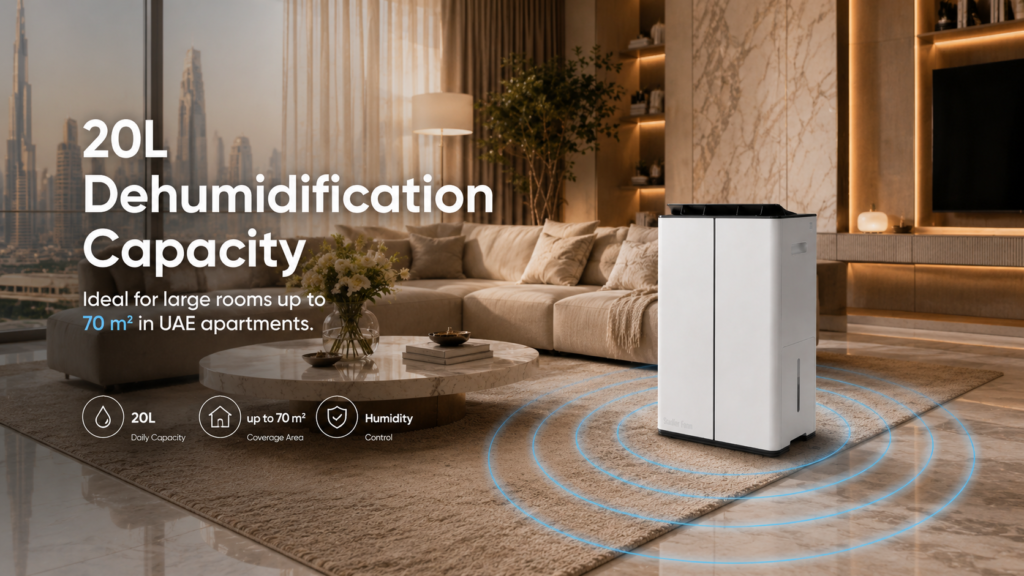
- Bedroom or small apartment: Albert, 20 litres a day for rooms up to 70 m², the quietest in the range at 33–44 dB(A), 270 W.
- Apartment with laundry drying indoors: Lukas, the same class with Wi-Fi app control and a laundry-drying mode, 260 W.
- Villa ground floor or open-plan living area: Lukas Pro, 50 litres a day for rooms up to 175 m² with a HEPA H11 filter included, 545 W and a five-year warranty.
Set the target to about 50–55 % relative humidity, use the drainage hose if the unit will run unattended, and let the AC do the cooling. Our UAE buying guide explains the sizing method in full.
Related reading: Best Dehumidifier in UAE 2026: buying guide · Mould and humidity in UAE indoor spaces · More in Dehumidifier Guides
Frequently asked questions
Yes, as a by-product of cooling: air passing over the cold coil drops below its dew point and water condenses out. But an air conditioner is controlled by a thermostat, so once the room reaches the set temperature it stops cooling and stops removing moisture, which is why humidity can stay high in a cool room.
No. Dry mode makes an air conditioner better at removing moisture by running the fan slowly, but it still cools the room and still works from a temperature reading rather than a humidity target. A dehumidifier has a hygrostat and holds a set relative humidity without cooling the space.
Only if measurements say so. Check with a hygrometer: if rooms sit at or above roughly 60 % relative humidity, or you see condensation, musty smells or damp in wardrobes, a dehumidifier will help. If the AC holds the room below about 50 %, you do not need one.
They do different jobs, so compare on the outcome. A dehumidifier’s rated power is 260–545 W depending on model and it runs only when humidity is above the set point, whereas dry mode keeps the air conditioner’s compressor working and continues to cool a room you may not want cooler.
Around 50–55 % relative humidity suits most homes, and keeping a room below about 60 % is the usual advice for limiting condensation and mould growth. Very dry air brings its own discomfort, so lower is not automatically better.