













Do Air Coolers Work in UAE Humidity? Air Cooler vs Fan vs AC
Partly, and it depends on where and when. An air cooler, also sold as a desert or evaporative cooler, cools air by evaporating water into it. That means it can never cool air below the air’s wet-bulb temperature, and it adds humidity as it works. On a typical August afternoon in Dubai, a good cooler can bring 41.5 °C air down to about 30 °C, but that air leaves the cooler at around 80 % relative humidity. In Al Ain, where the air is drier, the same cooler does noticeably better. For a closed room on the coast between May and October, an air conditioner with a fan beside it keeps you cooler and keeps humidity in check. A cooler is the right tool for dry months, inland homes and semi-open spaces.
How an air cooler cools, and why humidity sets the limit
A fan inside the cooler pulls air through wet pads. As the water evaporates it takes heat from the air, the same way wet skin feels cold in a breeze. The air comes out cooler, and wetter.
There is a floor to how cool that air can get: the wet-bulb temperature. It is the reading a thermometer shows when its bulb is wrapped in a wet cloth and air blows over it. In dry air it sits far below the normal temperature; in humid air it sits close to it. ASHRAE, the engineering society that sets many heating and cooling standards, says the cooled air “approaches the ambient air’s wet-bulb temperature”. Good rigid pads close 70 to over 95 % of the gap between the air temperature and the wet-bulb temperature; older, thin pads manage 50 to 80 %.
ASHRAE also gives a rule of thumb: direct evaporative cooling is not suitable for indoor comfort once the outdoor wet-bulb temperature is above about 21 °C (70 °F).
How much can an air cooler cool in Dubai and Al Ain, month by month?
We worked this out from the National Center of Meteorology’s long-term averages: the average daily maximum temperature, paired with the average daily minimum humidity, which usually comes with the afternoon heat. The wet-bulb temperature uses Stull’s 2011 formula, and the cooler is assumed to be 80 % effective, a good pad by ASHRAE’s range. Real days vary around these averages.
| Month | Dubai air (°C) | Dubai wet-bulb (°C) | Dubai air from a good cooler (°C) | Al Ain air (°C) | Al Ain wet-bulb (°C) | Al Ain air from a good cooler (°C) |
|---|---|---|---|---|---|---|
| Jan | 24.4 | 16.5 | 18.1 | 24.8 | 15.5 | 17.4 |
| Feb | 25.8 | 17.2 | 18.9 | 27.6 | 16.3 | 18.6 |
| Mar | 28.8 | 18.9 | 20.9 | 31.5 | 17.8 | 20.5 |
| Apr | 33.4 | 20.9 | 23.4 | 36.9 | 19.6 | 23.0 |
| May | 37.9 | 23.2 | 26.1 | 42.0 | 21.1 | 25.3 |
| Jun | 40.0 | 25.6 | 28.5 | 44.6 | 22.7 | 27.1 |
| Jul | 41.3 | 27.2 | 30.0 | 44.7 | 25.1 | 29.0 |
| Aug | 41.5 | 27.1 | 29.9 | 44.5 | 24.9 | 28.9 |
| Sep | 39.4 | 25.7 | 28.5 | 42.0 | 22.9 | 26.7 |
| Oct | 35.8 | 23.5 | 26.0 | 37.6 | 20.4 | 23.8 |
| Nov | 30.9 | 20.8 | 22.8 | 31.5 | 19.0 | 21.5 |
| Dec | 26.5 | 18.3 | 19.9 | 26.9 | 17.0 | 19.0 |
Stations: Dubai International Airport (1974–2025) and the Al Ain airport station, which the National Center of Meteorology now lists as Tahnoun International (1994–2025).
What the table shows:
- Dubai’s afternoon wet-bulb temperature is above ASHRAE’s 21 °C line from May to October. Al Ain crosses it from May to September, and only just in May.
- The cooler’s air is very humid. On an August afternoon in Dubai it leaves at about 80 % relative humidity, and on the US National Weather Service heat index, 30 °C at 80 % feels like about 37 °C. The index assumes shade and a light wind, so moving air feels a little better, but it is far from an air-conditioned 24 °C.
- These are afternoon figures. On the coast, humidity climbs to an average daily peak of 71 to 78 % in summer, so a cooler does even less in the evening and at night.
What an air cooler does to the humidity in your room
Every litre of water a cooler evaporates ends up as moisture in your room. The US Department of Energy says evaporative coolers “should not be used in humid climates because they add humidity to the air in your home”, and that if windows are not open far enough, “humidity will build up in the home”. ASHRAE adds that a direct evaporative cooler should not recirculate indoor air: as much air should leave the room as the cooler blows in.
So a cooler needs an open window or door. In a coastal summer, that lets hot, humid outdoor air into a home you are trying to keep cool.
Humidity matters for health and for the house. The US Environmental Protection Agency advises keeping indoor humidity below 60 %, ideally between 30 and 50 %, and notes that mould can cause asthma attacks in people with asthma who are allergic to it. The World Health Organization notes that most dust mites need relative humidity above 45–50 % to survive and develop. A cooler running in a closed coastal room pushes the air well past both lines.
If your rooms already feel damp with the AC on, our guide Does air conditioning remove humidity? explains why, and what helps.
Air cooler vs fan vs AC: what each one does
| Air cooler | Fan | Split AC | |
|---|---|---|---|
| Cools the air? | Yes, towards the wet-bulb temperature | No. The room stays at the same temperature | Yes, to the set point |
| Cools you? | Yes, when the air is dry enough | Yes, by moving air over your skin | Yes |
| Humidity | Adds moisture | No change | Removes some moisture while it cools |
| Windows | Must be open | Either | Closed |
| Power | 145 W for one portable model; around 1 kW for a mid-size whole-house unit | 18 to 40 W at full speed for the Stadler Form fans below | 1.51 kW rated for an LG 18,000 BTU/h (1.5-ton) inverter split |
| Cost of 8 hours on DEWA’s first slab | About AED 0.35 (145 W) | About AED 0.07 (30 W) | Up to about AED 3.70 at full power |
| Best for | Dry months, inland homes, semi-open spaces | Any room, with or without AC | Closed rooms in humid months |
Costs use DEWA’s first residential slab of 23 fils per kWh, plus the October 2026 fuel surcharge of 6 fils and 5 % VAT, about 30 fils per kWh in all. Higher slabs cost 28, 32 and 38 fils before the surcharge. An AC compressor cycles on and off, so its real use is usually lower than the full-power figure.
The cheapest upgrade: a fan with your AC
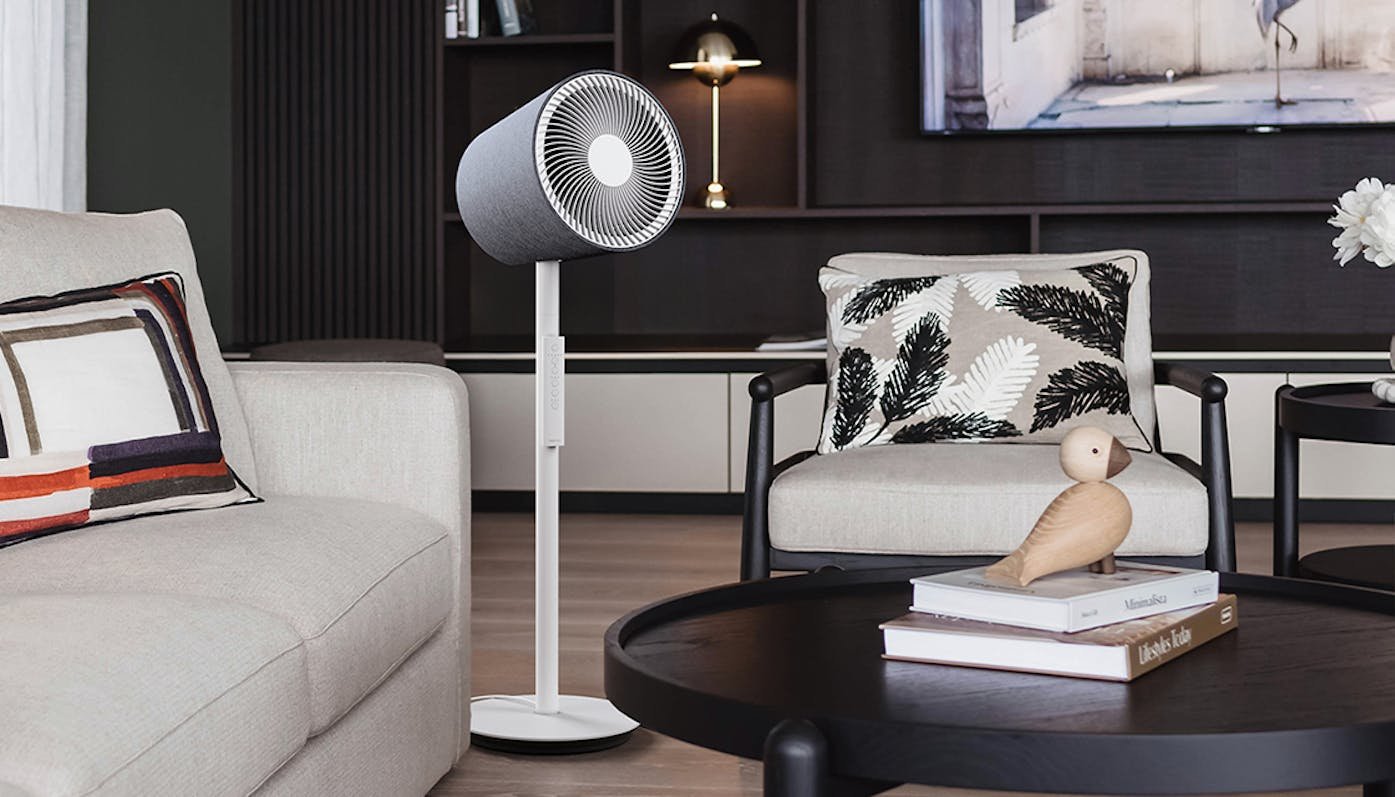
A fan does not cool a room. It cools you, by moving air over your skin, which is why it pays to switch it off when you leave. In the UAE that moving air is worth real money, because it lets you set the AC a little warmer without feeling the difference.
- The US Department of Energy says a ceiling fan lets you raise the thermostat by about 4 °F (about 2 °C) without reducing comfort.
- Research for the California Energy Commission by the University of California, Berkeley found fans can offset a 2.2 to 4.4 °C rise in room temperature while keeping people as comfortable. A Berkeley simulation study found that raising the cooling set point from 22.2 °C to 25 °C saved an average of 29 % of cooling energy.
- DEWA advises keeping the thermostat at 24 °C or higher, and says each degree higher “can save up to 5% on AC consumption”.
In practice: set the AC to 24 or 25 °C, point a fan at where you sit or sleep on a low or medium speed, and turn the fan off when you leave the room.
| Stadler Form fan | Power use | Air delivery | Noise |
|---|---|---|---|
| Leo | 1.5–18 W | 617 m³/h | 27–57 dB(A) |
| Simon | 2–23 W | 997 m³/h | 25–52 dB(A) |
| Peter tower fan | 3–30 W | Air speed 7.6 m/s | 29–56 dB(A) |
| Finn mobile fan | 3–40 W | 361 m³/h | 24–53 dB(A) |
One safety limit: a fan cools you only while the air is cooler than your body. The US CDC advises using fans only when indoor temperatures are below 90 °F (32 °C), because above that “a fan can increase body temperature”; the WHO sets its limit at 40 °C. If a room is hotter than about 32 °C, a fan alone is not enough: use AC or move somewhere cooler.
When an air cooler does make sense in the UAE
- Inland homes in the drier months. In Al Ain from October to April, afternoon wet-bulb temperatures stay below 21 °C, and a good cooler can take about 7 to 14 °C off the air.
- Semi-open spaces that AC cannot hold. Garages, workshops, warehouses with open doors and shaded outdoor seating need a constant flow of outside air anyway, so the cooler’s need for ventilation becomes a strength.
- Coastal homes, outside summer, with windows open. From November to April, Dubai’s afternoon wet-bulb temperature sits at or below about 21 °C.
- Not a closed bedroom on the coast between May and October. There, AC with a fan does the job, and keeps humidity down.
Keeping an air cooler clean and safe
- Check the pads, filters, water tank and pump at least once a month, and replace the pads at least twice a cooling season (US Department of Energy).
- Drain and clean the tank regularly. ASHRAE recommends cleaning and flushing the water circuit at least monthly, and disinfecting before and after.
- Western Australia’s health department lists home evaporative units as a potential source of Legionnaires’ disease, and advises draining and cleaning portable units and leaving them dry when not in use. ASHRAE says it knows of no Legionnaires’ cases linked to wetted-pad coolers, so the risk is low, but stagnant water is worth avoiding.
For most UAE homes the answer is simple. Keep the AC for closed rooms in the humid months and add a fan so you can set it warmer. Save the cooler for dry air and open spaces. Browse our fans to find one for your room.
Related reading: Does air conditioning remove humidity? · Living by the sea in Dubai: summer humidity indoors · More in Fans & Heating
Frequently asked questions
Do air coolers work in Dubai in summer?
Only partly. On a typical August afternoon a good cooler brings 41.5 °C air down to about 30 °C, but at around 80 % humidity. ASHRAE considers direct evaporative cooling unsuitable for indoor comfort once the outdoor wet-bulb temperature passes about 21 °C, which Dubai’s afternoons do from May to October.
Does an air cooler use less electricity than an AC?
Yes, much less. One portable cooler is rated at 145 W, while an 18,000 BTU/h (1.5-ton) split AC is rated at about 1.5 kW. But a cooler cannot do the same job in humid weather, so the saving only counts where the air is dry enough for it to work.
Is an air cooler or a fan better in the UAE?
In humid coastal weather, a fan used with AC is better: it adds no moisture, uses 18 to 40 W at full speed, and lets you set the AC warmer. In dry inland air or semi-open spaces, a cooler wins, because it cools the air itself, which a fan cannot.
Is an air cooler good for someone with asthma?
In a closed, humid room it can make things worse. It raises humidity, and the US EPA advises keeping indoor humidity below 60 % and notes that mould can cause asthma attacks in people with asthma who are allergic to it. In dry inland air, with windows open, the humidity rise is smaller.
Does a fan cool the room?
No. A fan moves air over your skin, which makes you feel cooler, but the room stays at the same temperature. Switch it off when you leave the room, and do not rely on a fan alone above about 32 °C, the limit the US CDC gives.
What AC temperature saves the most electricity in Dubai?
DEWA recommends 24 °C or higher and says each degree higher can save up to 5 % of AC consumption. The US Department of Energy says a ceiling fan lets you raise the thermostat by about 2 °C without losing comfort, so 24 to 25 °C with a fan is a practical setting.
Sources
- ASHRAE Handbook, HVAC Systems and Equipment, Chapter 41: Evaporative Air-Cooling Equipment
- US Department of Energy, Evaporative Coolers (archived 1 January 2026)
- US Department of Energy, Fans for Cooling (archived 1 January 2026)
- Southwest Energy Efficiency Project, New Evaporative Cooling Systems
- UAE National Center of Meteorology, Climate Yearly Report
- Stull (2011), Wet-Bulb Temperature from Relative Humidity and Air Temperature, Journal of Applied Meteorology and Climatology
- US National Weather Service, Heat Index
- US EPA, A Brief Guide to Mold, Moisture and Your Home
- WHO guidelines for indoor air quality: dampness and mould (2009)
- DEWA, Slab Tariff
- DEWA, Cooling tips
- LG, S4-Q18K23AA specifications
- Symphony, Diet 3D 30i personal air cooler
- California Energy Commission and UC Berkeley CBE, Integrating Smart Ceiling Fans and Communicating Thermostats (2022)
- Hoyt, Arens and Zhang (2014), Extending air temperature setpoints, Building and Environment
- US CDC, About Heat and Your Health
- WHO, Heat and health
- HealthyWA, Minimising the risk of a Legionella infection at home
The month-by-month figures are our own calculation from the National Center of Meteorology averages, using Stull’s formula and an assumed 80 % pad effectiveness from ASHRAE’s range. Fan figures are from Stadler Form’s technical data.