
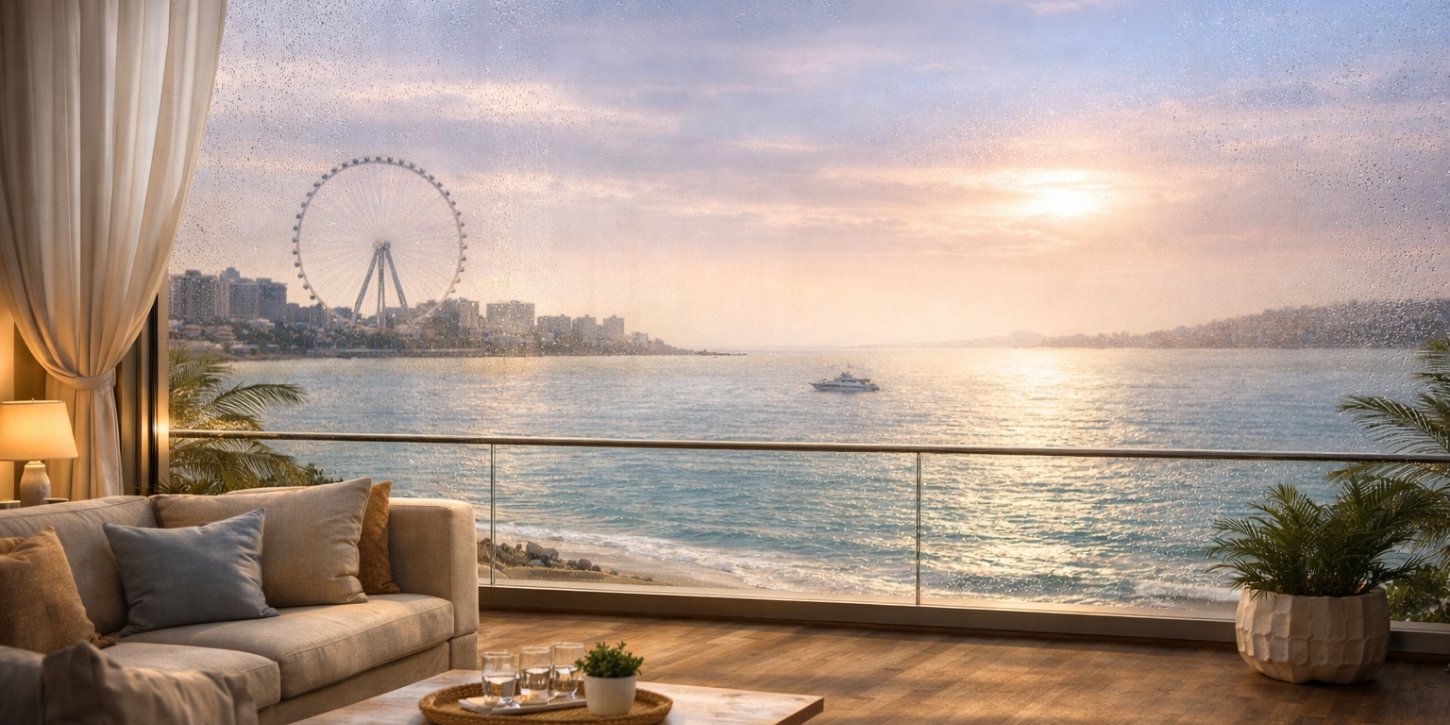
Living by the Sea in Dubai? Here’s How to Handle Summer Humidity Indoors
As summer approaches in the UAE, most conversations are about temperature – but for anyone living in a sea-facing apartment, humidity defines the season. Dubai Marina, JBR, Bluewaters Island, Palm Jumeirah and the Jumeirah coastline share a microclimate in which warm sea air carries far more moisture than the air a few kilometres inland.
High-rise and sea-facing apartments feel it most. Moisture enters every time a balcony door opens, through ventilation and around window frames, and in a compact, sealed flat it has nowhere to go. Even early mornings can feel damp, and evenings bring a noticeable heaviness to the air.
Air conditioning helps, but it may not solve the problem on its own. It removes some moisture as part of the cooling process, yet it may not maintain the desired indoor relative humidity under every operating condition – particularly in a small apartment that reaches its set temperature quickly and then switches off. The result is a flat that feels cool but not truly comfortable. A hygrometer reading above 60 % confirms the cause.
The signs are subtle at first: glass that fogs, a wardrobe that smells musty, curtains and sofas that feel slightly damp, laundry that takes far longer to dry indoors during the summer months.
Over time the effects become visible. Wood warps, paint bubbles, and electronics stored in humid rooms deteriorate faster. Bathrooms and storage areas become prone to mould and mildew in corners and behind furniture where airflow is limited – even in carefully designed interiors in Jumeirah or Bluewaters, simply because of the surrounding environment.
There is a comfort dimension too. Humid air feels warmer and heavier than dry air at the same temperature, and health authorities such as the US EPA associate damp indoor environments with respiratory symptoms and recommend keeping indoor humidity below 60 %, ideally 30–50 % (EPA guidance).
Managing humidity in a coastal apartment means going beyond temperature control and addressing moisture directly. A well-regulated flat feels lighter, fresher and far more liveable at the peak of summer.
For most apartments, a 20-litre-class dehumidifier is the right size. Where quiet matters most – a bedroom or a one-bedroom flat – the Stadler Form Albert (up to 20 L/day, rooms up to 70 m², 33–44 dB(A)) is the natural choice. For a larger apartment with indoor laundry and app control, the Stadler Form Lukas (20 L/day, Wi-Fi, laundry mode) fits. For a large sea-facing penthouse or an open-plan floor above 70 m², the Stadler Form Lukas Pro (rated up to 50 L/day, up to 175 m²) is the higher-capacity option.
As the UAE summer sets in along the coast, the right-sized dehumidifier keeps a sea-facing apartment comfortable rather than compromised. If you live in a coastal villa rather than an apartment, our separate guide to dehumidifiers for villas near the sea and lakes covers that case.
Frequently asked questions
Sea air along Dubai Marina, JBR, Palm Jumeirah and Bluewaters carries far more moisture than inland air, and it enters every time the balcony door opens. Air conditioning removes some moisture as it cools, but it may not maintain the desired relative humidity under every operating condition, so a flat can feel cold and damp at the same time. A hygrometer reading above 60 % confirms it.
For a bedroom or a one-bedroom flat where quiet matters: Stadler Form Albert (20 L/day, up to 70 m², 33–44 dB(A)). For a larger apartment with indoor laundry and app control: Lukas (20 L/day, Wi-Fi, laundry mode). For a large sea-facing penthouse or open-plan floor above 70 m²: Lukas Pro (rated up to 50 L/day, up to 175 m²). All are Swiss-designed and supported by Stadler Form UAE’s own service centre.