









How to dry clothes indoors in the UAE: faster, drier and without the musty smell
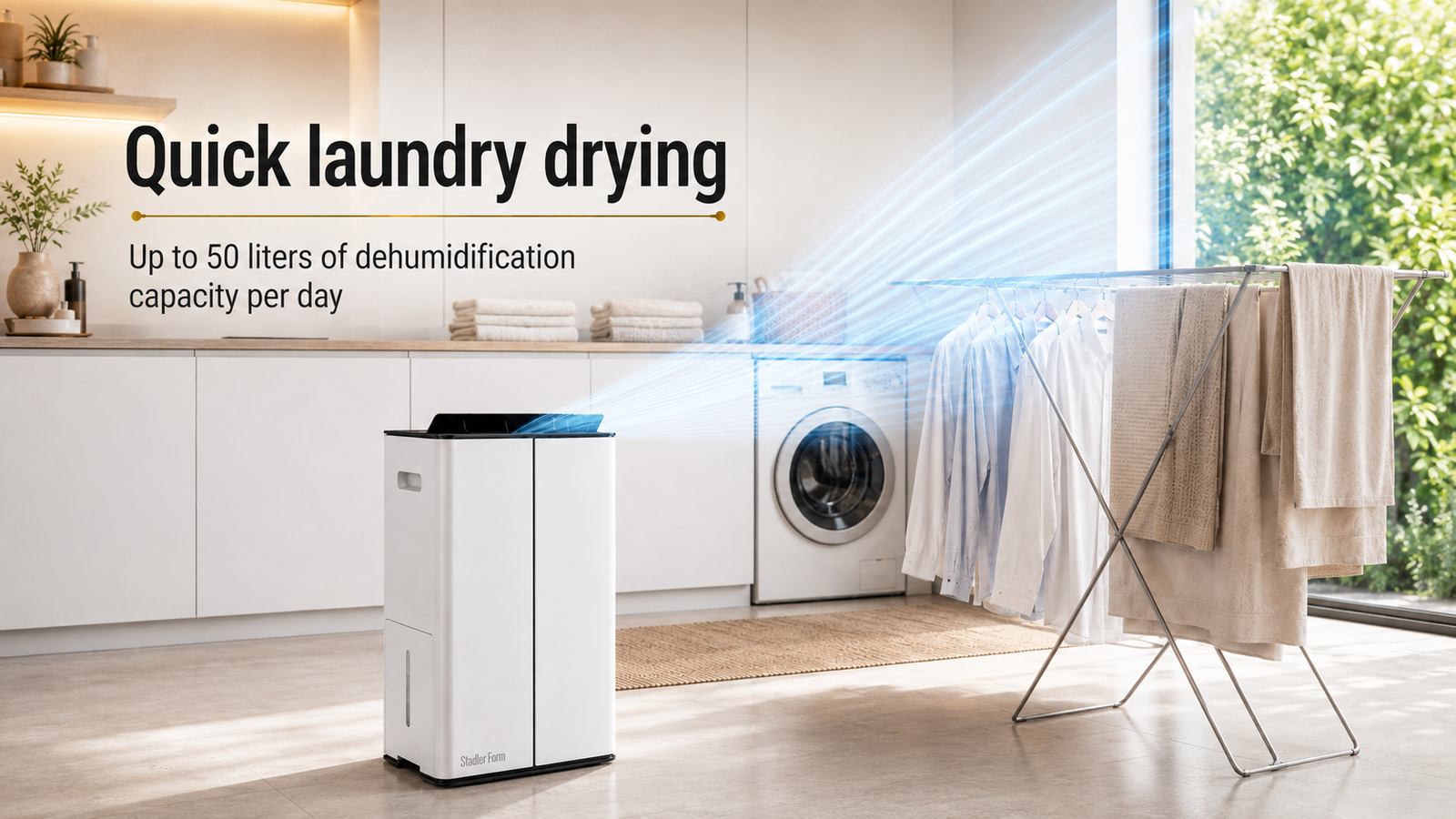
The short answer: Dry laundry in a small closed room with a dehumidifier running next to the rack. A wet load holds litres of water, and without help that water ends up in your room air, which slows drying and leaves clothes smelling musty. A dehumidifier keeps the air dry so the clothes keep drying. Lukas and Lukas Pro have a dedicated laundry-drying mode that blows dry air across the rack.
Why drying laundry is a UAE apartment problem
In many UAE towers, the balcony is not an option. Dubai Municipality has asked residents not to hang laundry on balconies or windows, as part of its campaign to protect the look of the city. Gulf News reported fines of AED 500 to AED 1,500 for misusing balconies, depending on the size of the balcony, and many developers and building managers add their own rules.
That leaves the clothes rack in the living room or a spare bedroom. In an air-conditioned apartment, that is where the trouble starts.
How much water is in a load of wet laundry?
More than most people think. Washing machines are rated by how much water they leave in the clothes after the spin, as a share of the clothes’ dry weight:
| Spin class (EU energy label) | Water left in the laundry | In a 7 kg load |
|---|---|---|
| A | less than 45% | up to about 3 litres |
| B | 45–54% | about 3–3.8 litres |
| C | 54–63% | about 3.8–4.4 litres |
Researchers at the Glasgow School of Art’s Mackintosh Environmental Architecture Research Unit measured the same effect in real homes. They found that an average load of washing releases around 2 litres of moisture into the air as it dries. In poorly ventilated rooms, they found indoor drying could account for up to a third of the moisture in the air.
Every litre that leaves your clothes goes into the room. In a closed, air-conditioned apartment it has nowhere to go.
Why clothes dry slowly, and smell, in an air-conditioned room
Clothes dry when water evaporates from the fabric into the air. That only keeps happening while the air around them is drier than the clothes. Two things work against you indoors:
- The air fills up. As the load evaporates, the humidity around the rack climbs. The more humid the air, the slower the clothes dry.
- Cool air slows evaporation. Water evaporates more slowly at 22–24 °C than outdoors in the UAE heat, so a load that dries quickly outside can stay damp for hours inside.
Slow drying is also what causes the familiar damp, sour smell. A 2012 study in Applied and Environmental Microbiology traced this malodour in laundry hung to dry indoors to a bacterium, Moraxella osloensis, which produces a compound called 4-methyl-3-hexenoic acid. The researchers found the bacterium is highly tolerant to drying and UV light, which helps it survive in laundry. The practical lesson is simple: the less time clothes spend damp, the better they smell.
The moisture does not stay in the clothes either. Damp rooms are where mold grows and where dust mites thrive. Best Dehumidifiers explains the science in its guide to dust mites and humidity in UAE homes.
How a dehumidifier speeds up indoor drying
A dehumidifier pulls the humid air around the rack over a cold coil, turns the water vapour back into liquid and collects it in its tank. The air it returns to the room is drier, so the clothes keep drying instead of stalling. In effect, the water moves from your clothes to the dehumidifier tank instead of into your walls, sofa and wardrobes.
A laundry mode goes one step further. On Lukas and Lukas Pro, the laundry-drying mode uses the swing outlet to move dry air across the rack, so the air touching the clothes is replaced all the time.
Step by step: drying laundry indoors with a dehumidifier
- Spin on the highest setting your fabrics allow. Every litre the machine removes is a litre the air does not have to absorb.
- Choose a small room and close the door. A spare bedroom, study or laundry room works best. The dehumidifier then only has to dry that room, not the whole apartment.
- Space the clothes out. Leave gaps between items and hang heavy pieces, such as towels and jeans, on the outside of the rack where the air reaches them first.
- Place the dehumidifier at least 50 cm from the clothes. Never let water drip onto the unit. This is the safety distance given in the Stadler Form instructions.
- Switch on laundry mode on Lukas or Lukas Pro, and point the swing outlet towards the rack.
- Use the drain hose for large loads. Lukas has a 4.2-litre tank that switches the unit off when full. For back-to-back loads, connect the included hose for continuous drainage.
- Check the clothes, then switch back to normal mode. Once the laundry is dry, return to your usual humidity setting, or let the hygrostat take over.
Which Stadler Form dehumidifier is best for drying clothes?
| Model | Laundry-drying mode | Capacity | Power | Best for |
|---|---|---|---|---|
| Lukas | Yes, with swing outlet | 20 L/day, rooms up to 70 m² | 260 W | Apartments, laundry in a spare room, Wi-Fi control from the app |
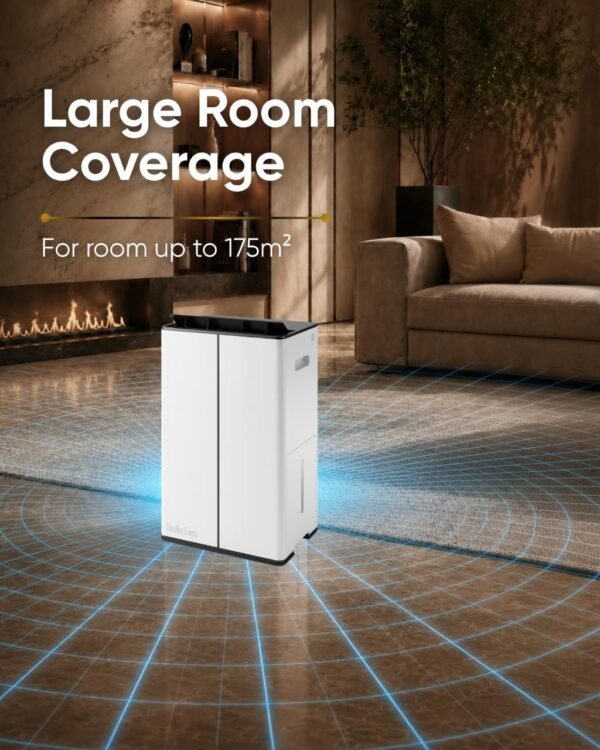
| Lukas Pro | Yes | 50 L/day, spaces up to 175 m² | 545 W | Villas, large laundry rooms, families washing every day |
| Albert | No dedicated mode | 20 L/day, rooms up to 70 m² | 270 W | Bedrooms where quiet matters most (from 33 dB(A)); it still dries the room air around a rack |
For most apartments, Lukas is the one to choose for laundry. If you wash daily for a large family, or dry laundry in a big utility room, choose Lukas Pro.
What it costs in electricity
Power use is easy to work out: multiply the power by the hours it runs. Lukas uses 260 W, so four hours of laundry drying uses about 1.04 kWh. Lukas Pro uses 545 W, so the same four hours uses about 2.2 kWh. Your actual use depends on the load, the room and how long the compressor runs.
Common mistakes to avoid
- Drying in a large open-plan room. The dehumidifier ends up drying the whole living area and the laundry dries more slowly.
- Leaving the door open. Humid air from the rest of the home keeps flowing in.
- Draping clothes over the dehumidifier or AC units. It blocks the airflow and risks water getting into the unit.
- Drying in a closed wardrobe or on bedding. Moisture soaks into fabrics that are hard to dry out again.
Frequently asked questions
Is it OK to dry clothes indoors in Dubai?
Yes, as long as the moisture is removed. A load releases litres of water as it dries. In a closed, air-conditioned apartment that water raises indoor humidity unless a dehumidifier collects it. Dry laundry in a small closed room with a dehumidifier running.
Can you hang laundry on your balcony in Dubai?
Dubai Municipality has asked residents not to hang laundry on balconies or windows. Gulf News reported fines of AED 500 to AED 1,500 for misusing balconies, and many buildings have their own rules. Check with your building management.
Does a dehumidifier dry clothes faster?
Yes. It removes the water vapour that evaporates from the clothes, so the air around the rack stays dry and the clothes keep drying. A dehumidifier with a laundry mode, such as Lukas, also moves dry air across the rack.
Why do my clothes smell when I dry them indoors?
Research has traced the damp, sour smell of indoor-dried laundry to a bacterium, Moraxella osloensis, which produces a compound called 4-methyl-3-hexenoic acid. Slow drying gives it more time. Drying laundry quickly is the practical fix.
Which Stadler Form dehumidifier has a laundry mode?
Lukas and Lukas Pro both have a dedicated laundry-drying mode. Lukas suits apartments and rooms up to 70 m². Lukas Pro suits villas and spaces up to 175 m².
How far should the dehumidifier be from the clothes?
At least 50 cm, with no water dripping onto the unit. Point the outlet towards the rack and keep the door closed.
Sources
- Gulf News, Hanging clothes in the balcony? These are the fines you face (27 December 2021).
- AEG, What’s the difference between spin classes in washing machines? (EU energy label spin-drying classes).
- The Glasgow School of Art, Mackintosh Environmental Architecture Research Unit, Research highlights health and economic problems caused by our indoor drying habits (2 November 2012).
- Kubota, H. et al. (2012). Moraxella species are primarily responsible for generating malodor in laundry. Applied and Environmental Microbiology, 78(9), 3317–3324.
- Stadler Form product pages and instructions for Lukas, Lukas Pro and Albert (capacity, power, tank, laundry mode, safety distance).