

Best Dehumidifier in UAE 2026: Choosing the Right Model for Apartments, Villas & Large Rooms
The best dehumidifier for a UAE home depends on eight things: the size of the space, how severe the humidity is, the machine’s rated extraction capacity, its airflow, how loud it is, how it drains, whether you also want air purification, and what warranty and local support come with it. Get those right and the choice of model becomes straightforward.
For a typical apartment, a 20-litre-class dehumidifier is usually enough. For a large villa, an open-plan living area that connects several rooms, or a home that suffers from heavy humidity every summer, a higher-capacity 50-litre-class machine makes more sense – and if you also want cleaner air, a unit that combines dehumidification with HEPA filtration saves buying two appliances. This guide explains how to size a dehumidifier for Dubai and the UAE, compares the Stadler Form range honestly against each other, and looks fairly at cheaper marketplace alternatives.
Quick answer: which dehumidifier for which home?
- Best for large villas and open-plan spaces: Stadler Form Lukas Pro – 50 L/day, rated for rooms up to 175 m²
- Best for apartments and medium-sized rooms: Stadler Form Lukas – 20 L/day, rated for rooms up to 70 m², Wi-Fi control
- Best for straightforward dehumidification: Stadler Form Albert – 20 L/day, up to 70 m², the quietest of the three at 33–44 dB(A)
- Best for humidity plus air purification in large rooms: Stadler Form Lukas Pro – HEPA H11 filter included, 327 CADR
- Best budget choice: compare marketplace models carefully on noise, extraction, energy use, warranty and local support (details below)
How to choose a dehumidifier in the UAE: the eight factors that matter
1. Room size. Every dehumidifier has a rated room size in m² or m³. Use it as your starting point, and remember that rooms connected by open doors behave as one large space.
2. Humidity severity. A coastal villa, a ground floor, a basement, a laundry room or a home near a pool carries a far higher moisture load than a fifth-floor apartment inland. Heavier load means a higher capacity class or a second unit.
3. Extraction capacity. Dehumidifiers fall into capacity classes – roughly 10, 20 and 50 litres per day. The class determines how quickly the machine reaches your target humidity and how easily it holds it (see the note on what “50 L/day” means below).
4. Airflow. Dry air has to reach the far side of the room. Fan levels and a swing function that moves the outlet make a large difference in open-plan spaces.
5. Noise. Compare the dB(A) range, and pay attention to the lowest setting rather than the maximum – that is what you will run at night. Around 40 dB(A) or below is quiet enough for a bedroom.
6. Drainage. A larger tank means less emptying; automatic shut-off when the tank is full is essential; a hose connection for continuous drainage lets the unit run unattended.
7. Air purification. Removing moisture and filtering particles are different jobs. Only some dehumidifiers also carry a true HEPA filter – useful if dust and sand are part of your problem.
8. Warranty and local support. Check how many years of warranty apply in the UAE, who services the machine, and whether replacement filters and parts are stocked locally.
What size dehumidifier do I need in Dubai?
Start from the manufacturer’s rated room size rather than the litres. Stadler Form rates its dehumidifiers like this:
- Up to 40 m² (100 m³): a 10-litre-class unit such as Theo – a bedroom, study or small storage room.
- Up to 70 m² (175 m³): a 20-litre-class unit such as Lukas or Albert – most one- and two-bedroom apartments, or the main living area of a townhouse.
- Up to 175 m² (435 m³): a 50-litre-class unit such as Lukas Pro – a villa ground floor, a large open-plan apartment or an office.
Two practical rules follow. First, add up the connected space: if your living room, dining area and kitchen open into each other, the dehumidifier is treating all of them, so a 100 m² open-plan floor is already beyond the 70 m² rating of a 20-litre unit. Second, if the room is on a coastal plot, on the ground floor, or used for drying laundry, move up a class. A 150 m² villa floor is squarely 50-litre territory; a 60 m² apartment is not.
What does “50 L/day” actually mean?
Rated capacity is measured under controlled laboratory conditions – a fixed temperature and a high relative humidity – so that machines can be compared fairly. Stadler Form’s technical data, for example, quotes power consumption at 30 °C and 80 % RH for one model and at 26.7 °C and 60 % RH for another, a reminder that every figure depends on conditions. In a cooler, air-conditioned UAE room the air holds less water, so a 50-litre unit will not physically fill 50 litres of tank every day. It extracts less than its rating – but still far more than a 20-litre unit in the same room. The US Energy Star programme explains the same principle for pint-rated machines in its dehumidifier guidance.
Treat the number as a capacity class, not a daily promise. What a higher class buys you is speed: it reaches your target humidity faster and holds it with less running time.
Stadler Form Lukas Pro: the high-capacity choice for villas and large rooms
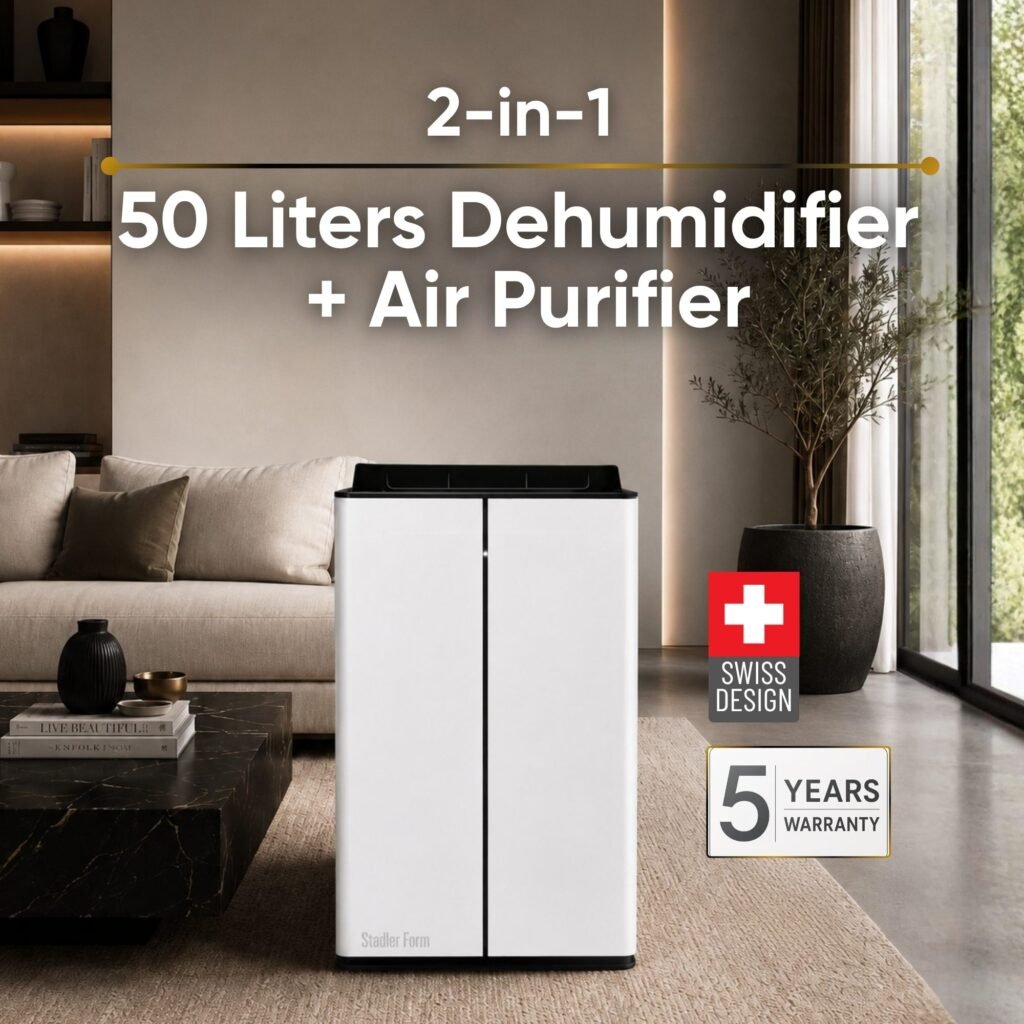
The Stadler Form Lukas Pro 50L Dehumidifier & Air Purifier is the model to look at when a standard household unit is not enough. A 50-litre-class dehumidifier gives owners of larger villas and open-plan areas significantly more moisture-removal capacity than a conventional 20-litre unit, and Lukas Pro is rated for rooms of up to 175 m² (435 m³) – roughly the ground floor of a UAE villa or a full-floor apartment.
It is also a genuine air purifier. A HEPA H11 filter is included, and as a purifier it delivers 327 CADR, enough to exchange the air in a 131 m² room once every hour; in independent laboratory testing the filter removed over 99.99 % of germs (tested with Staphylococcus albus). A particle sensor shows air quality in real time (white, yellow or red), and dehumidification can be switched off to run purification alone on dusty but dry days.
For a machine this size it is quiet: 38–55 dB(A) across the fan levels, with night mode from 38 dB, which is why it is used in bedrooms and hotel suites as well as basements. Wi-Fi and the Stadler Form app give remote control, schedules and a digital hygrostat; the touch panel does the same locally. A laundry-drying mode speeds up indoor drying, the swing function spreads dry air across the room, and drainage is your choice – a 5.2-litre tank with automatic switch-off, or the included hose for continuous drainage so the unit can run 24/7 unattended. Power consumption is 545 W; the unit weighs 18 kg and measures 382 × 650 × 287 mm.
Lukas Pro belongs to Stadler Form’s Pro Series and carries a five-year warranty, supported in the UAE by Stadler Form UAE’s own service centre and engineers. At the time of writing (September 2026) it is priced at AED 3,850. For a deeper look, read our complete Lukas Pro review.
Stadler Form Lukas: the right size for most apartments
For many UAE apartments, buying the largest dehumidifier available is unnecessary. The Stadler Form Lukas provides a more appropriately sized alternative for people who want Stadler Form’s smart features and humidity control without the capacity or physical size of Lukas Pro.
Lukas removes up to 20 litres a day and is rated for rooms up to 70 m² (175 m³). It has the same Wi-Fi app control, digital hygrostat, four power levels, timer, laundry-drying mode, swing function and night mode as its bigger brother, plus a child lock and a defrost function. Noise is 38–52 dB(A), the tank holds 5.2 litres with automatic shut-off, a drainage hose is included for continuous operation, and power consumption is 260 W. It weighs 15.8 kg and measures 358 × 572 × 254 mm.
Air purification is optional rather than built in: adding the HEPA H11 filter for Lukas turns it into a dehumidifier and air purifier for a smaller area, or you can buy it bundled as the Lukas Smart. Lukas is priced at AED 2,450 at the time of writing and comes with a two-year warranty. If you live in an apartment, our guide to Lukas for UAE apartments goes into more detail.
Stadler Form Albert: straightforward dehumidification
Albert remains a good option for someone whose priority is straightforward dehumidification rather than having every smart or air-purification feature. The Stadler Form Albert removes up to 20 litres in 24 hours and is rated for rooms up to 70 m², the same class as Lukas, but it does without Wi-Fi.
What it keeps is what matters for humidity control: an integrated hygrostat so the unit holds a set humidity level, a digital 24-hour timer, a swing function for air distribution, automatic shut-off when the tank is full, and a drainage hose for continuous operation. Its 4.6-litre tank has a carrying handle. Albert is also the quietest of the three at 33–44 dB(A), which makes it a natural bedroom dehumidifier. Power consumption is 270 W; it weighs 13.3 kg and measures 350 × 655 × 252 mm. It carries a two-year warranty, is priced at AED 1,850 at the time of writing, and has earned the Amazon’s Choice badge for dehumidifiers in the UAE.
Are cheaper dehumidifiers worth considering?
Yes, in the right situation. There are many good-value dehumidifiers available through Amazon UAE, Noon and other online marketplaces, including models from Chinese manufacturers and private-label brands. Some offer impressive extraction capacity for the price. The trade-off on certain budget models can be higher operating noise, simpler build quality, fewer smart features or less-established local after-sales support.
If noise is not an important concern – for a laundry room, a storage room or an area where the machine will not run beside you while you sleep or work – some of these budget models can offer very good value. Before buying any dehumidifier, compare the same points across the models you are considering:
- Noise: the dB(A) rating, and at which fan setting it was measured
- Extraction capacity: litres per day and the test conditions behind the figure
- Energy consumption: watts, and whether the unit has an auto mode that stops when the target humidity is reached
- Warranty: how many years, and who honours it in the UAE
- Local support: service centre, spare parts and response times
- Drainage: tank size, automatic shut-off, and whether a continuous-drainage hose is supported or included
- Replacement filters: availability and cost
- Humidistat / hygrostat: can you set a target humidity, or only a fan speed?
- UAE specification: 220–240 V, 50 Hz and a Type G plug – imports designed for other markets may need adapters or transformers
Which type of dehumidifier should you choose?
| Situation | Recommended class | Stadler Form option |
|---|---|---|
| Small room, light humidity | 10-litre class (rated up to about 40 m²) | Theo |
| Apartment | 20-litre class (rated up to about 70 m²) | Lukas or Albert |
| Medium home, several rooms | 20-litre class per zone, or step up if the rooms are open to each other | Lukas / Albert, or Lukas Pro for an open plan |
| Large villa or large open-plan area | 50-litre class (rated up to 175 m²) | Lukas Pro |
| Humidity plus air purification | Dehumidifier with a HEPA filter | Lukas with the optional HEPA filter, or Lukas Pro (filter included) for large rooms |
| Simple humidity control | 20-litre class with hygrostat and timer | Albert |
| Budget, noise not critical | Marketplace model, after comparing the specifications above | – |
20L vs 50L dehumidifier: which one do you need?
Bigger is not automatically better. A 20-litre machine makes more sense for most normal apartments: it is smaller, lighter, uses less power and is rated for the space you actually have. Running a 50-litre unit in a 50 m² flat simply means it cycles on and off more often.
A 50-litre machine becomes the right answer when the area is much larger than 70 m², when the humidity load is heavier (coastal, ground floor, basement), when doors and open spaces connect several rooms into one volume, when you want moisture removed quickly rather than over a whole day, when laundry is dried indoors several times a week, or when the machine will serve a large residential space such as a villa. In those cases a 20-litre unit will run flat out and still fall behind, while a 50-litre unit such as Lukas Pro reaches the target and then idles – quieter and more efficient in practice. Our article on Lukas Pro for UAE villas walks through a typical villa layout.
Can one machine dehumidify and purify the air?
Yes, but only if it is built to do both, because the two jobs are different. A dehumidifier removes moisture from the air by condensing it on a cold coil; it does nothing about dust. A HEPA air purifier draws air through a dense filter that, by definition, captures at least 99.97 % of particles of 0.3 microns (US EPA: what is a HEPA filter?) – dust, sand, pollen and other airborne particles – but it does not remove humidity, and a particle filter on its own does not remove gases or odours.
Lukas Pro combines the two functions in one housing – compressor dehumidification plus a HEPA H11 filter with 327 CADR – which makes it attractive for a customer who would otherwise buy two separate appliances for a large room. Lukas offers the same combination for smaller rooms when fitted with its optional HEPA filter. If dust is your only problem, a dedicated air purifier is the simpler choice; if humidity is your only problem, Albert is. We compare the two approaches in why a 2-in-1 dehumidifier and air purifier makes sense for UAE homes.
Why UAE homes can still have high indoor humidity even with air conditioning
Air conditioning removes some moisture as a side effect of cooling, but only while it runs, and it was never designed as a dehumidifier. Indoor humidity in a UAE home is pushed up by outdoor humidity that regularly exceeds 80 % in summer along the coast; by doors opening and closing all day; by bathrooms, showers and cooking; by laundry drying indoors; by fresh-air ventilation that brings humid air in; by the building itself (single glazing, ground floors, poorly sealed frames); and by how the AC is set. An oversized or aggressively set system cools the room quickly and switches off before it has removed much moisture, so the air ends up cold and damp – which is exactly when condensation appears on windows and cold walls.
The US EPA recommends keeping indoor relative humidity below 60 %, ideally between 30 and 50 %, to discourage mould growth (EPA: mould, moisture and your home). Most UAE homes in summer sit well above that without help. A dehumidifier with a hygrostat holds the room at a set level regardless of what the AC is doing; see our guide on mould in UAE homes for the warning signs.
Where should you place a dehumidifier?
Put it where the air moves – near the centre of an open-plan area or by the hallway that connects rooms – rather than tucked behind furniture. Leave the clearance around the inlet and outlet that the manual specifies, keep windows closed while it runs, and for a single problem room (a laundry room, a basement bedroom) close the door so the machine works on that space alone. If you use continuous drainage, position it within hose reach of a floor drain or outlet with a downward run for the hose.
Frequently asked questions
There is no single best dehumidifier for every UAE home. For large villas and open-plan spaces the Stadler Form Lukas Pro (50 L/day, rooms up to 175 m², HEPA air purification, 5-year warranty) is the strongest choice in the Stadler Form range. For a typical apartment the 20 L/day Lukas or Albert (rooms up to 70 m²) is the better fit, and for buyers focused on price, marketplace models can make sense if noise and after-sales support are less important.
For a large Dubai villa, a high-capacity dehumidifier such as the Stadler Form Lukas Pro is usually more suitable than a standard 20 L model, because it offers up to 50 L/day rated moisture extraction, is rated for rooms up to 175 m², drains continuously through a hose and also filters the air with a HEPA H11 filter.
Usually yes. Stadler Form rates its 20 L/day models – Lukas and Albert – for rooms up to 70 m², which covers most one- and two-bedroom apartments. Move up to a 50 L class if the apartment is open-plan and larger than about 70 m², faces the sea, or is used for frequent indoor laundry drying.
When the space is much larger than 70 m², when several rooms are open to each other, when the humidity load is heavy (coastal, ground floor, basement, pool house), when you dry laundry indoors often, or when you want moisture removed quickly rather than over a whole day. In those situations a 20 L unit runs continuously and still falls behind.
For a large room or open-plan area in the UAE, choose a unit rated for the whole connected space. The Stadler Form Lukas Pro is rated for rooms up to 175 m² (435 m³) with 50 L/day extraction and a swing function to distribute dry air, which is why it is the model recommended for large living areas, majlis rooms and offices.
Yes. Lukas Pro is designed for large spaces: 50 L/day capacity, a 175 m² room rating, continuous drainage through the included hose so it can run unattended, Wi-Fi control from anywhere, and a HEPA filter for dust. Very large villas may still need one unit per floor or per closed zone.
Capacity and purification. Lukas removes up to 20 L/day for rooms up to 70 m² and takes an optional HEPA filter; Lukas Pro removes up to 50 L/day for rooms up to 175 m² and includes the HEPA H11 filter with 327 CADR. Both have Wi-Fi app control, a hygrostat, laundry mode, night mode and a 5.2-litre tank with hose drainage. Lukas Pro is larger and heavier (18 kg vs 15.8 kg) and carries a five-year rather than two-year warranty.
Both are 20 L/day dehumidifiers rated for rooms up to 70 m² with a hygrostat, timer, swing function and drainage hose. Lukas adds Wi-Fi app control, a laundry-drying mode, a child lock and an optional HEPA filter; Albert is simpler, slightly quieter (33–44 dB(A) versus 38–52 dB(A)), lighter and lower priced. Choose Lukas for smart features and optional air purification, Albert for straightforward dehumidification.
Only if it is built with a real particle filter. Standard dehumidifiers have a dust screen, not a HEPA filter. The Stadler Form Lukas Pro includes a HEPA H11 filter and is rated as an air purifier at 327 CADR; Lukas can be fitted with an optional HEPA filter. A HEPA filter captures airborne particles; it does not remove humidity, gases or odours.
Partly. Air conditioning condenses some moisture while it cools, but only while the compressor runs, and an oversized or aggressively set system switches off before it has removed much water. With outdoor humidity above 80 % in summer and doors opening all day, most Dubai homes stay above the recommended 50–60 % indoors unless a dehumidifier with a hygrostat holds the level.
Yes. Condensation forms when humid indoor air meets a cold surface such as a window or an AC-cooled wall. Lowering indoor relative humidity with a dehumidifier reduces the amount of moisture available to condense, so windows and walls stay dry.
Yes, as part of controlling moisture. Mould needs damp surfaces to grow, and the US EPA recommends keeping indoor humidity below 60 %, ideally 30–50 %. A dehumidifier with a hygrostat keeps a room in that range. It does not remove existing mould, which must be cleaned and its moisture source fixed.
Very. With a hose connected to a floor drain or outlet, the dehumidifier runs 24/7 without anyone emptying a tank – essential for villas, basements, laundry rooms, holiday homes and any space left unattended. Lukas Pro, Lukas, Albert and Theo all include a drainage hose.
Yes. A dehumidifier pulls moisture out of wet clothes hanging indoors and dries them faster in a closed room. Lukas and Lukas Pro have a dedicated laundry-drying mode that uses the swing function to move dry air across the washing.
For a bedroom or living room, look for a lowest setting of around 40 dB(A) or below – roughly a quiet library. Among Stadler Form models, Albert runs at 33–44 dB(A), Lukas at 38–52 dB(A) and Lukas Pro at 38–55 dB(A) with night mode from 38 dB. For a laundry or storage room, noise matters far less.
They can be, for the right room. Many marketplace models offer good extraction for the price; the compromises on some budget units are higher noise, simpler build quality, fewer smart features and weaker local after-sales support. If the unit will run in a laundry or storage room rather than beside you at night, compare noise, capacity, energy use, warranty, drainage, filter availability and UAE voltage carefully – it may be a sensible choice.
It is the rated extraction capacity measured under controlled laboratory conditions of temperature and high humidity so that models can be compared. In a cooler, air-conditioned UAE room the machine extracts less than the rating, but a 50 L/day unit still removes far more than a 20 L/day unit under the same conditions and reaches the target humidity faster.
Where the air moves: near the centre of an open-plan area or the hallway that links rooms, with the clearance around inlet and outlet that the manual specifies, and away from the back of furniture. Keep windows closed while it runs. For one problem room, close its door so the unit treats that space alone; for continuous drainage, place it within hose reach of a drain.
Conclusion: what dehumidifier should you actually buy in Dubai?
Match the machine to the space and the problem. For large villas, large open-plan areas and homes with a heavy humidity load – or whenever you want dehumidification and HEPA air purification in one unit – the Stadler Form Lukas Pro is the strongest choice in the range, because its 50 L/day capacity, 175 m² rating, continuous drainage and five-year warranty are built for exactly that job. For a typical apartment or medium-sized home, Lukas gives you the same smart control at the right size. If you simply want reliable, quiet humidity removal without the extras, Albert remains a strong, simpler option. And if price is the main concern and the unit will run somewhere noise does not matter, a carefully compared marketplace model can also make sense. Whichever class you land in, browse the full range of dehumidifiers in the UAE or call Stadler Form UAE on +971 4 343 5501 for advice on your specific rooms.
Related reading: Stadler Form Lukas Pro Review: 2-in-1 Dehumidifier and Air Purifier for Large Rooms in the UAE · Signs You Need a Dehumidifier in the UAE: Musty Smells, Condensation and Damp Air